Envelope Deep Dive · Interior Comfort
Sound Insulation Between Rooms
Thermal insulation keeps heat where it belongs; acoustic treatment keeps sound where it belongs. The two overlap — the same cellulose and mineral wool installed for warmth also absorbs sound — but quieting a house obeys different physics. This page explains how sound moves between rooms, what the ratings mean, and which assemblies actually deliver a quiet bedroom, office, or in-law suite.
The physics of noisy houses
Airborne vs. impact sound — and why they need different cures
Sound crossing a partition travels two ways, and the distinction decides the fix (the ASHRAE Handbook's sound and vibration chapters treat them separately for exactly this reason):
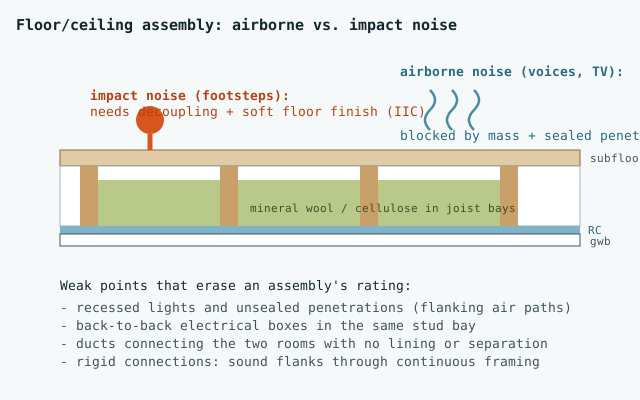
- Airborne sound — voices, TV, music — is pressure waves in air striking one face of the wall or ceiling, vibrating it, and re-radiating from the other face. It's rated by STC (Sound Transmission Class), measured per ASTM E90/E413. Higher is better: around STC 35 loud speech is intelligible through the wall; around STC 45–50 loud speech is a murmur; 50+ is the multifamily code benchmark (the IBC requires STC 45 field-tested / 50 lab between dwelling units — a useful target for any "I don't want to hear them" wall in a single-family home too).
- Impact sound — footsteps, dropped toys, chair scrapes — is vibration injected directly into the structure, which carries it far more efficiently than air. It's rated by IIC (Impact Insulation Class) for floor/ceiling assemblies. No amount of cavity insulation fixes footsteps by itself; impact noise demands decoupling and soft surfaces.
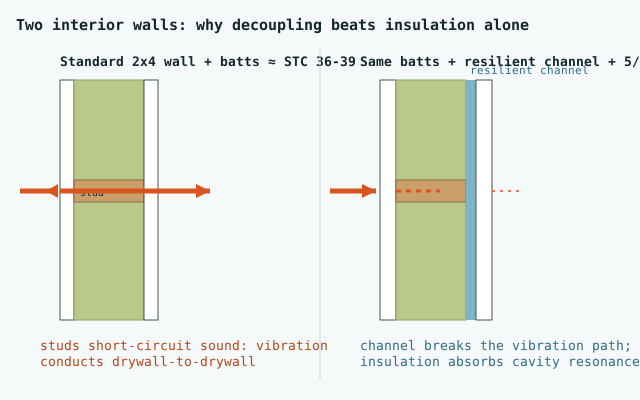
Four levers control both, in rough order of power: airtightness (sound leaks through the same gaps air does — a 1% open area can pass a huge share of the sound), mass (heavier faces vibrate less; 5/8″ drywall, doubled layers), decoupling (break the rigid vibration path: resilient channel, staggered or double studs), and absorption (fibrous insulation in the cavity damping resonance). Absorption alone — insulation in a standard wall — is the weakest lever, worth only a few STC points; it becomes powerful in combination with decoupling, which is the pairing shown below.
Assemblies that work
From "take the edge off" to "home office over the playroom"
| Assembly | Approx. rating | Best for |
|---|---|---|
| Standard 2×4 wall, empty, ½″ drywall | ~STC 33 | The baseline most Maine interior walls are at today |
| Same wall + fibrous insulation (dense-pack retrofit or batts) | ~STC 36–39 | Takes the edge off; the practical retrofit for closed walls — done from small holes like thermal dense-pack |
| Insulation + resilient channel + 5/8″ drywall (one side re-skinned) | ~STC 46–50 | Bedrooms, offices, media walls — the workhorse renovation upgrade |
| Staggered-stud or double-stud wall, insulated, 5/8″ both sides | STC 50–60+ | New partitions: in-law suites, rental units, music rooms |
| Floor/ceiling: insulated bays + resilient channel + 5/8″ ceiling; add pad-and-carpet or a floated floor above for IIC | STC/IIC 50+ range | Bonus rooms, bedrooms under living areas, apartments over garages |
Ratings are laboratory-order approximations for comparison; field performance runs several points lower and is set by the weakest flanking path, not the wall section. Solid-core doors with perimeter seals are mandatory companions — an undercut hollow door caps any wall at hallway-door performance.
Seal it like you mean it
Acoustic performance is won at the perimeter and the penetrations: caulked plates, sealed (not back-to-back) electrical boxes, putty pads, and no open duct shortcuts between the rooms. This is the same discipline as thermal air sealing — an airtight partition is a quiet partition — and it's why sound scopes and energy scopes are best handled by the same crew with the same sealants.
Where sound and energy scopes overlap
If you're dense-packing exterior walls for heat anyway, adding interior partition walls to the fill list costs little and buys STC 36–39 room separation house-wide. If you're insulating a floor over the basement or garage for thermal reasons — or building the zone boundaries discussed on the next page — specifying mineral wool and resilient channel turns the same assembly into the acoustic one. One mobilization, two problems solved.
Want specific rooms quieter?
Tell one of our recommended installers which wall or ceiling and what's on the other side of it. They'll scope the assembly that hits your target — and fold it into any weatherization work for one visit.
Quote a Quiet Room