Building Science · Part 3 of 3 · BPI Standards
Why Air Sealing Comes First
Adding insulation to a leaky house is like putting on a wool sweater in a stiff wind. The Building Performance Institute — the national standards body for home performance — treats the house as a system, and in that system, controlling air movement is job one. Here's the case for air sealing, and how professional air sealing is actually done.
The need for air sealing
Your house exchanges its entire volume of heated air — over and over, every day
A typical older Maine home leaks so much air that its full volume of heated air is replaced by cold outdoor air one to two times every hour on a windy winter day. Every one of those air changes is fuel you already paid to burn, exhausted to the outdoors through hundreds of individual gaps: the chase around the chimney, the holes drilled for wiring and plumbing, the tops of interior walls, recessed lights, the attic hatch, the sill and rim joist where the house meets the foundation.
Three forces drive that exchange: wind, mechanical equipment (fans and combustion appliances), and — dominating everything in a Maine winter — the stack effect, the chimney-like buoyancy of warm air inside a cold-surrounded building. Air leakage matters so much because it attacks the home four ways at once:
- Energy: Escaping air carries heat bodily out of the building (convective loss), bypassing the insulation entirely. In leaky homes, air leakage commonly rivals or exceeds conductive losses through walls and ceilings. In summer, the same paths pull in hot, humid air that your heat pump or AC must then cool and dehumidify.
- Comfort: Cold drafts at floors, rooms that never warm up, and the "cold 68°" feeling that pushes thermostats to 72°.
- Moisture and durability: Exfiltrating indoor air carries water vapor into cold attics and wall cavities, where it condenses — feeding mold, rotting sheathing, and building the ice dams Maine roofs are famous for.
- Insulation performance: Air moving through fibrous insulation strips away its rated R-value. Sealing first is what lets the insulation you buy actually perform.
Why "just add more insulation" fails
Blowing insulation over an unsealed attic floor buries the leaks without stopping them — warm, moist air keeps streaming through open chases and top-plate gaps into the attic, now hidden under a foot of cellulose where it condenses against cold sheathing. Sealing after insulating means excavating the insulation you just paid for. This is why every credible standard, and every Efficiency Maine weatherization project, sequences air sealing before insulation.
The standards behind the work
What the Building Performance Institute requires
The Building Performance Institute (BPI) is the ANSI-accredited standards developer and certification body for the home performance industry in the United States. BPI-certified professionals and BPI standards are the technical backbone of weatherization programs nationwide, including the assessment practices used in Efficiency Maine's residential programs. The principles below come from BPI's published standards and its Building Analyst body of knowledge.
1. The house is a system
BPI's foundational doctrine is that a home's envelope, mechanical equipment, and occupants interact as one system. Change one part — tighten the envelope, add a bath fan, swap a furnace — and you change the pressures, airflows, and moisture behavior of the whole house. That's why BPI-based work never treats "insulation" as an isolated product: it is one intervention in a system that must stay healthy, dry, and safe after the work is done.
2. Measure, don't guess: the blower door
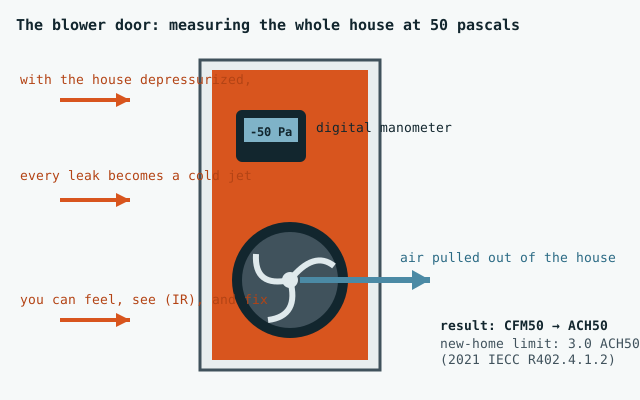
BPI's home-assessment standard calls for a whole-building airtightness measurement using a blower door: a calibrated fan sealed into an exterior doorway that depressurizes the house (typically to 50 pascals) while a manometer measures airflow. The result — expressed in CFM50 or converted to air changes per hour (ACH50) — quantifies total envelope leakage before and after work, so improvement is verified, not assumed.
With the house depressurized, technicians walk the building with smoke pencils and infrared cameras and the leaks announce themselves — cold air jets from every bypass. The blower door turns air sealing from guesswork into a measured trade. See our blower door testing guide for the full conversion from CFM50 to dollars. It's the same instrument and metric the 2021 IECC uses for new Maine homes (maximum 3.0 ACH50, §R402.4.1.2), which means existing homes can be scored on the exact scale the code applies to new construction.
3. Seal the big holes at the top and bottom first
Because the stack effect makes pressures greatest at the very top and very bottom of the house, BPI-trained crews prioritize the attic plane and the basement — the leaks with the highest pressure across them do the most damage. The classic hit list, in rough order of impact:
- Open chases: chimney chases (sealed with sheet metal and fire-rated sealant), plumbing vent chases, duct chases, dropped soffits over kitchens and baths
- Attic hatches and pull-down stairs (gasketed and insulated — the 2021 IECC §R402.2.5 requires hatches insulated to the surrounding assembly's R-value and weatherstripped)
- Top plates of interior and exterior walls; wiring and pipe penetrations
- Recessed lights (boxed or replaced with sealed IC-rated units)
- Balloon-framed wall cavities open to the attic or basement
- The rim/band joist and sill in the basement; utility penetrations; bulkhead doors
4. Build tight, ventilate right — and verify combustion safety
Tightening a house changes its pressure balance, so BPI's assessment standard requires combustion appliance zone (CAZ) testing — checking that furnaces, boilers, and water heaters still draft safely under worst-case depressurization, and testing for carbon monoxide and gas leaks. It also requires evaluating whole-house ventilation against ASHRAE Standard 62.2, so a tightened home receives deliberate, filtered fresh air (often via bath-fan upgrades or an HRV) instead of accidental drafts.
This is the part of air sealing that separates professionals from foam-gun enthusiasm. A Maine home with an atmospherically vented oil boiler or gas water heater must be tested after tightening; "build tight, ventilate right" is the standard, and it's why professional crews — including our recommended installers — carry combustion analyzers alongside caulk guns.
What it looks like on a real job
The air sealing sequence a quality installer follows
- Test in. Blower door baseline (CFM50/ACH50), infrared scan, CAZ and CO safety screen, moisture inspection.
- Seal the attic plane. Chases, top plates, penetrations, lights, hatch — with fire-rated materials where required around flues and chimneys.
- Seal the bottom. Rim joist and sill (typically closed-cell foam or cut-and-sealed rigid board), foundation penetrations, bulkhead.
- Address sidewall bypasses found during the scan — balloon framing, pocket doors, cantilevers, porch roof intersections.
- Test out. Repeat the blower door, verify the reduction, re-verify combustion safety, and confirm ventilation meets ASHRAE 62.2 — adding mechanical ventilation if the house is now tight enough to need it.
- Then insulate. With the air barrier restored, attic, wall, and foundation insulation finally performs at its rated R-value. See how the finished envelope works →
Every step is documented — pre/post blower door numbers and photos — which is also exactly the documentation Efficiency Maine expects from Registered Vendors on rebated weatherization projects.
Get your house tested before you buy anything
One blower door test tells you whether your money should go to air sealing, insulation, or both — and in what order. Assessments are free, and the numbers are yours to keep.
Book a Blower Door Assessment