Envelope Deep Dive · The Top of the Box
Attic & Roof Insulation In Depth
The attic is where Maine houses lose the most — the warmest air in the house sits against the coldest surface, pushed by the full force of the stack effect. It's also the most cost-effective place to fix. This page covers vented attics, cathedral ceilings, finished Capes and kneewalls, hatches, ventilation, and ice dams.
Why the attic dominates
Maximum temperature difference, maximum stack pressure, maximum payback
Heat loss through any assembly is proportional to the temperature difference across it (the ASHRAE Handbook of Fundamentals expresses this as Q = U × A × ΔT). Because warm air stratifies, the air against your ceiling is the warmest in the house — often several degrees above thermostat setting — while a vented attic above tracks outdoor temperature. No other assembly in the building sees a bigger ΔT for more hours of the year. Stack effect then adds insult: the ceiling plane sits at the top of the pressure column, where indoor air is pushed out hardest (see the stack effect page), so every ceiling penetration exfiltrates heated, moisture-laden air all winter.
That's why the 2021 IECC's biggest single change for Maine was raising the attic requirement to R-60 — and why attic air sealing plus insulation is the first-priority measure in nearly every BPI-style assessment and Efficiency Maine weatherization project.
Assembly by assembly
The vented attic: seal the floor, baffle the eaves, bury it deep
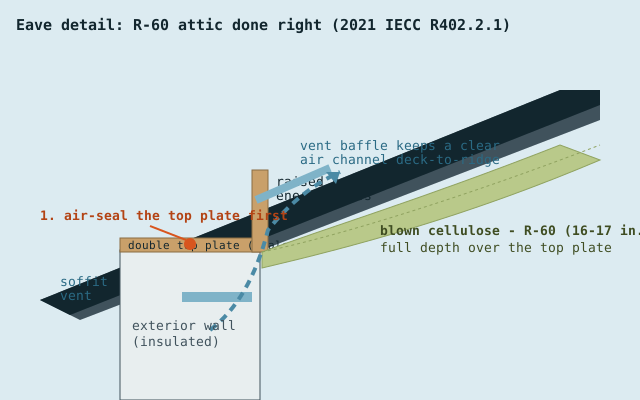
The classic — and still the best — Maine roof is a vented attic with insulation at the floor: cheap to insulate to R-60, self-drying, and cold on purpose so the snow on the roof stays frozen. The sequence:
- Air-seal the attic plane first. Chimney and plumbing chases, top plates, wiring penetrations, dropped soffits, recessed lights, bath fan housings. This is the step that stops the stack effect and the moisture ride-along. (Full detail on the air sealing page.)
- Baffle every rafter bay at the eaves so ventilation air from the soffits passes over the insulation instead of through it — wind washing can strip several R's from unprotected loose fill; the IRC requires the vent channel and a baffle where soffit vents are used (IRC §R806.3).
- Dam and insulate the hatch. IECC §R402.2.5: access hatches and doors must be insulated to the R-value of the surrounding assembly and weatherstripped, with retainers so loose fill can't spill.
- Blow to R-60 — roughly 16–17 inches of cellulose — with depth markers every few hundred square feet and a certificate of installed R-value and coverage (the industry-standard attic card).
Ventilation: the roof's drying mechanism, not an energy feature
Attic vents don't save energy — they protect the roof. The IRC (§R806) requires net free vent area of 1/150 of the attic floor (reducible to 1/300 with a balanced high/low split and, in our climate zone, a ceiling vapor retarder), moving outdoor air from soffit to ridge to carry away any moisture that gets past the ceiling and to keep the deck cold. Ventilation is the backstop; air sealing is the actual moisture control. A well-sealed ceiling with modest venting outperforms a leaky ceiling with a wide-open ridge every time.
Ice dams: an attic problem wearing a roof costume
Ice dams form when escaping heat melts the snow blanket from below; meltwater runs to the cold eave and refreezes into a dam that backs water under the shingles. The cure is the same trio as the energy fix — air-seal the ceiling, insulate deep and full to the eave (raised heel), ventilate soffit-to-ridge. Heat cables treat the symptom; the attic work removes the cause.
The hard cases
Cathedral ceilings, finished Capes, and kneewalls
Cathedral / sloped ceilings
When the insulation must live in the rafter bays themselves, depth is scarce and drying is limited. Two sound approaches in Zone 6:
- Vented cathedral: a continuous baffle channel under the deck from soffit to ridge, the bay dense-packed or filled below it, and an interior air barrier without gaps. Works when rafters are deep enough for meaningful R plus the vent channel.
- Unvented (hot roof): the IRC (§R806.5) permits unvented roof assemblies when air-impermeable insulation (closed-cell foam, or rigid foam above the deck) supplies enough of the total R directly against the sheathing to keep it above condensation temperature — in Zone 6 that ratio matters; getting it wrong grows mold on the deck. This is engineering-grade work, and it's the assembly the code's re-roofing exception points to when an exposed, uninsulated roof deck must be insulated above or below the sheathing (see code-triggered upgrades).
The Cape and the bonus room
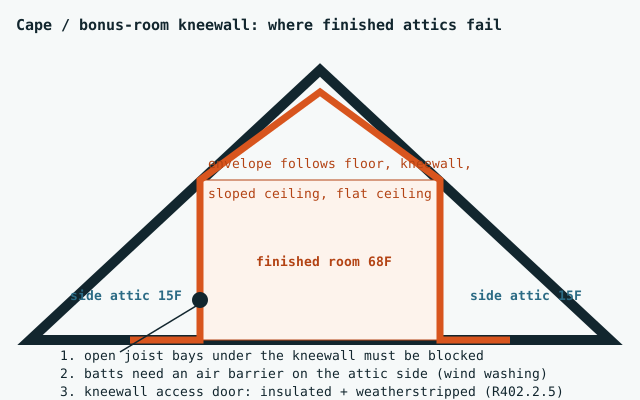
Finished half-stories are Maine's most common comfort complaint: roasting in July, arctic in January. The envelope has to zig-zag — floor of the side attic, up the kneewall, along the slope, across the flat ceiling — and every transition is a failure opportunity. The three chronic defects are open joist bays running under the kneewall (a highway for attic air beneath the heated floor), batts with no air barrier on their attic side, and uninsulated access doors. All three are fixable from the side attics without demolition.
Code corner — attics
New construction and additions: R-60 ceiling, Zone 6/7 (2021 IECC Table R402.1.3), raised-heel R-49 allowance (§R402.2.1), limited R-30 area for ceilings without attic space (§R402.2.2), insulated/weatherstripped hatches (§R402.2.5), eave baffles (§R402.4.1.1 / IRC R806.3). Existing homes: finishing an attic into living space is a change of space conditioning triggering full compliance for the new conditioned envelope (§R501.1.1 → §R502) — details on the triggered upgrades page.
Attic first. It's almost always attic first.
Our recommended installers seal, baffle, dam, and blow to R-60 — with pre/post blower door numbers and the Efficiency Maine rebate handled. Ice dam problems welcome.
Get an Attic Assessment